


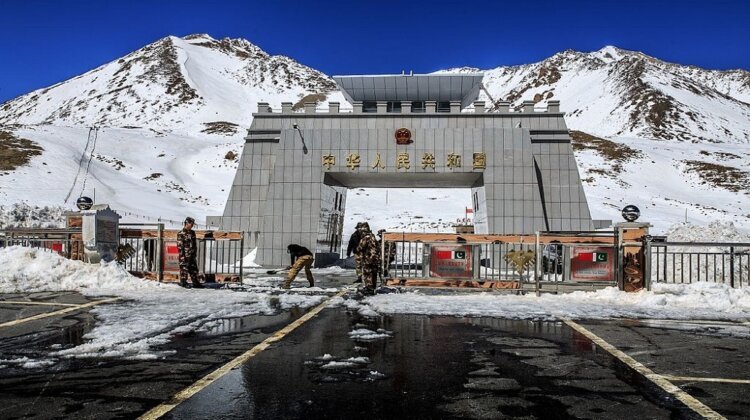
Move follows 60-day traders’ protest at Sost border; court to review legality of federal taxes in GB
ISLAMABAD: The Supreme Court of Pakistan has admitted a petition challenging the Federal Board of Revenue’s (FBR) alleged illegal collection of income and sales taxes from traders in Gilgit-Baltistan (GB), a region constitutionally exempt from federal taxation.
The petition, filed by Muhammad Raziq, Member Executive Committee of the Federation of Pakistan Chambers of Commerce and Industry (FPCCI), was lodged under Article 184(3) of the Constitution, invoking the apex court’s jurisdiction over matters concerning fundamental rights.
According to the petition, the FBR has been unlawfully collecting sales tax and income tax on imports from China at the Sost Dry Port, despite GB’s tax-exempt status. The plea maintains that such taxation violates the fundamental economic rights of GB residents, as goods imported through Sost are consumed entirely within the region, which is outside the purview of Pakistan’s national tax regime.
After a preliminary hearing, the Supreme Court ordered that the petition be numbered under Article 184(3) as a Public Interest Petition and placed before an appropriate bench for regular hearing. The petitioner was represented by Advocate Hafiz Munawar Iqbal (ASC).
This major legal development comes weeks after traders in GB ended a two-month-long protest at the Sost border following a government-brokered agreement that granted conditional tax relief.
The protest, which began in late July 2025, saw thousands of traders, customs agents, and transporters suspend trade between Pakistan and China via the Khunjerab Pass, bringing cross-border commerce worth billions to a standstill.
The standoff ended in last week of September after the federal government announced significant tax exemptions for local traders and residents of GB. The agreement, reached after negotiations led by Energy Minister Sardar Awais Leghari and FBR Chairman Rashid Mahmood Langrial, provided that sales tax, income tax, and federal excise duty would no longer be collected at Sost, while customs and regulatory duties would continue as per law.
Under the new arrangement, only local firms registered with the GB government are eligible for tax exemption, with the total fiscal relief capped at Rs 4 billion per annum.
FBR Chairman Langrial had acknowledged that while GB’s traders were constitutionally exempt, there had previously been no mechanism to verify who qualified for exemption. The new system, he said, was designed to ensure “fairness without compromising the integrity of tax laws.”
The Supreme Court’s intervention, however, is being viewed as a significant test of the federal government’s authority in a constitutionally disputed region. Legal experts say the case could set a precedent on whether federal tax laws can be enforced in Gilgit-Baltistan without an act of Parliament or constitutional amendment defining its legal status.
Observers note that the outcome could have far-reaching implications — not just for GB’s fiscal autonomy, but also for trade under the China-Pakistan Economic Corridor (CPEC), where the Sost border remains a vital commercial gateway.


