


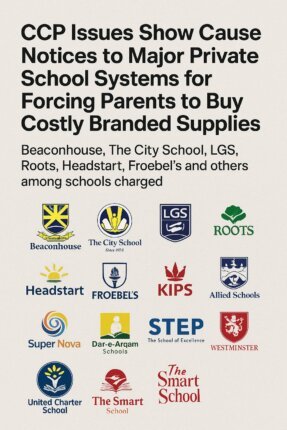
Beaconhouse, City School, LGS, Roots, KIPS, Allied, Dar-e-Arqam, Froebel’s, Super Nova, Westminster and other major school chains face CCP scrutiny for tying mandatory branded materials with enrollment.
ISLAMABAD: In a major action addressing one of the most persistent concerns of parents across Pakistan, the Competition Commission of Pakistan (CCP) has issued show-cause notices to seventeen leading private school systems for allegedly abusing their dominant position by forcing families to purchase expensive, branded notebooks, uniforms and other supplies exclusively through school-approved vendors.
For years, parents have complained about the rising cost of private schooling—not only through frequent fee hikes but also through compulsory purchases of logo-branded items that significantly inflate education expenses. CCP’s enforcement action seeks to curb these practices at a time when record inflation has already pushed household budgets to the brink.
Parents’ Complaints Spark Inquiry
The suo motu action was prompted by a surge of complaints from parents and guardians who alleged non-transparent pricing, arbitrary fee structures and compulsory “study packs” bundled with branded stationery, workbooks and uniforms. These items were often sold at prices far higher than comparable products available in open markets.
The school networks under scrutiny include some of the country’s largest chains—Beaconhouse, The City School, Headstart, Lahore Grammar School (LGS), Froebel’s, Roots International, Roots Millennium, KIPS, Allied Schools, Super Nova, Dar-e-Arqam, STEP School, Westminster International, United Charter School and The Smart School, among others.
Collectively, these systems operate hundreds of campuses and educate millions of children, giving them substantial influence over parents who often have limited alternatives for quality schooling.
Inquiry Finds Students Treated as “Captive Consumers”
The CCP inquiry discovered that many schools required parents to purchase logo-bearing notebooks, workbooks, uniforms and related items from exclusive school-appointed vendors. In some cases, students were barred from bringing generic notebooks or non-branded uniforms.
Key findings include:
- Mandatory study packs were priced up to 280% higher than similar items available in the open market.
- Several school chains engaged in tying arrangements, making the purchase of branded items a condition for continued enrollment.
- Exclusive vendor agreements effectively shut out thousands of small retailers nationwide.
- These practices violated Sections 4(1) and 4(2)(a) of the Competition Act, 2010.
Because parents often face high switching costs limited school options, heavy transfer fees, transport constraints the inquiry found that families had no practical alternative but to comply.
Impact on Household Budgets and Small Retailers
Almost half of Pakistan’s students are enrolled in private educational institutions. With inflation already eroding incomes, the added burden of overpriced branded supplies has become a major source of frustration for families. The CCP noted that these practices not only restrict consumer choice but also harm small stationery shops and uniform sellers nationwide.
Next Steps & Possible Penalties
The seventeen school systems have been directed to submit written replies within 14 days and appear before the Commission to explain their conduct. Failure to do so may result in ex-parte proceedings.
Under the law, CCP can impose penalties up to 10% of annual turnover or PKR 750 million whichever is higher.
The Commission stressed that ensuring fairness in the education sector is critical, as anti-competitive practices directly impact millions of families striving to provide quality education to their children.


