


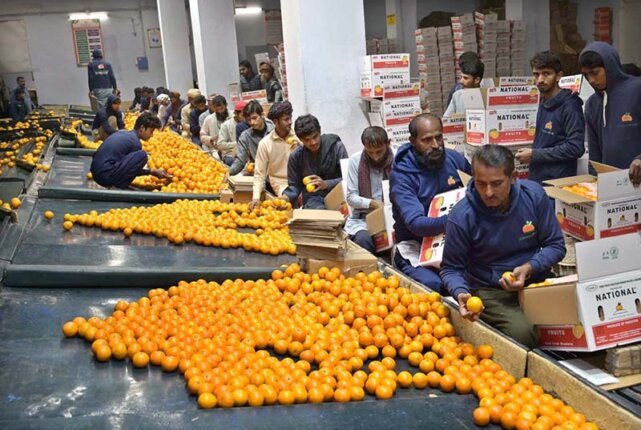
Islamabad: Pakistan’s citrus exports have declined sharply during the current year, falling by 30.28 percent compared to 2023 and 24.32 percent compared to 2024, despite major institutional reforms introduced in the country’s national plant protection organization and agricultural trade regulatory framework.
The decline has raised serious concerns among exporters and stakeholders, particularly as the reforms were introduced with the stated objective of improving compliance with international sanitary and phytosanitary standards and increasing Pakistan’s agricultural exports.
As part of the reform process, the federal government moved to abolish the Department of Plant Protection (DPP) which had been blamed for corruption, stagnant exports and repeated compliance issues in international markets. DPP was established as National Plant Protection Organization of Pakistan under Article IV of International Plant Protection Organization (IPPC) to whom Pakistan has been signatory since November 10, 1954.
In its place, the legislatures promulgated National Agri Trade and Food Safety Act, 2025 resciding earlier Pakistan Plant Quarantine Act, 1976 as desired by the prime minister of Pakistan. Under new act, the National Agri-Trade and Food Safety Authority has also been established by the prime minister, aimed at strict oversighting and strengthening food safety, plant quarantine, and export facilitation mechanisms.
However, stakeholders claim that the transition has not produced the desired results and the authority has failed to even oversight unbribled corruption, illegal clearance in exchange of enticement, restore the previous export statistics of agricultural commodities during the Imran Khan led former Government. They argue that instead of improving technical capacity in accordance with Interantional agreement, the reform process weakened the institutional framework by removing most qualified and experienced technical officers in regulation of plant quarantine, pesticides standardization from key positions.
Further, Saram Bukhari, (Country Team Lead for Pakistan at the U.S. Soybean Export Council (USSEC) for market development and strengthens partnerships between the U.S. soy industry and Pakistani stakeholders), Dr. Nuzhat Qaiser (CEO of Usama Dairies Training & Research Institute, private entity), Dr. Farkhanda Manzoor (Director General of Youth Lead Climate Change (YLCC) Pakistan & former vice chancellor of Lahore woman university), Dr. Muhammad Azeem Khan (former Chairman, Pakistan Agriculture Research Council with specialization in PBG), Dr. Masood Rabbani (Chairman/Dean/VC, University Veterinary & Animal Sciences, Lahore holding degree of veterinary medicine), Syed Yawar Ali (Chairman of Nestlé Pakistan Limited, Wazir Ali Industries Limited and Pakistan Dairy Association.), & Mr. Zain Iftikhar Chaudhry (CEO of Welcon Chemical & COO of Warble Pvt. Ltd., and son of ruling party MNA, Mr. Iftikhar Nazir Chaudhry) were included member of Board of Governors of NAFSA.
Experts critisized that no expert with respect to plant quarantine and food safety from any university, research institute were included in the Authority. In order to occupy key posts in technical authority during service as side posting and even after retirement, Waseem Ajmal Chaudhry, former Secretary, MoNFSR (disputed financial integrity, allegedly named in multiple mega corruption scandal) and Dr. Syed Bilal Haider, former Joint Secretary Admn, MoNFSR (came into lime light in media as front man of Farah Gogee for alleged extorting bribe in exchange of managing posting of civil servants in Punjab) had also prescribed general qualification and experience instead of specific qualification and experience for detection, identification, and control of insects, plant pathogens, weeds, and contaminants for regulation of exportable and importable regulated goods.
According to sources, one senior-most technical officer and former Direcrtor General, Dr. Muhammad Tariq Khan was surrendered to the surplus pool, another, Dr. Shehzad was dismissed from service, while another officer Dr. Allah Ditta Abid, was sent on forced retirement, while the fourth, Dr. Muhammad Basit was suspended from his position based on, what they claim, false, baseless and malicious charges just to adjust their favourites. These actions, stakeholders allege, were taken under the influence and desire of a former bureaucrat-turned-politician.
Technical experts have also questioned the appointment of customs officers to senior regulatory posts in the DPP. They claim that such appointments were made on the recommendation of Mr. Rashid Mehmood Langrial, Chairman Federal Board of Revenue and on the basis of administrative and political considerations, despite the officers allegedly lacking the required technical qualifications and experience in plant protection, plant quarantine, and pesticide standardization.
Exporters argue that plant quarantine and sanitary and phytosanitary regulation require specialized scientific expertise, particularly for commodities such as citrus, mango, potato, rice, wheat, corn, sesame, chili, dates, which are subject to strict international market access requirements.
Stakeholders further stated that, unlike international best practices, Pakistan’s regulatory system has increasingly been placed under non-technical bureacratic administrators. They said officials trained primarily in revenue collection and customs enforcement may not be equipped to manage complex export certification systems involving pest surveillance, orchard accreditation, cold treatment, and compliance audits.
Sources in the citrus export sector said that during the current export season, regular surveys of citrus orchards were allegedly not conducted before exports to identify and accredit pest-free areas and pest-free production sites. Similarly, compliance audits of citrus processing plants and cold storages were reportedly not carried out for accreditation purposes to ensure that standard cold treatment protocols were followed before export.
Exporters believe that these omissions may have affected Pakistan’s ability to meet the phytosanitary requirements of importing countries and could be one of the reasons behind the decline in citrus shipments.
Pakistan’s citrus sector, particularly kinnow exports, has long faced challenges including pest-related restrictions, inconsistent quality, limited cold chain compliance, and changing international market standards. However, stakeholders say that the latest decline is especially concerning because it has occurred at a time when the government had promised major reforms to boost exports.
They have urged the federal government to review the reform process, restore technical leadership in plant protection institutions, and ensure that appointments to key regulatory posts are based on professional qualifications and relevant experience.
They warned that unless the government strengthens technical capacity and ensures science-based regulation, Pakistan may continue to lose its share in international citrus markets despite institutional restructuring.


