


Students in Pakistan scored an average of 38 per cent in mathematics and 47 per cent in science in a nationwide study presented at the Aga Khan University (AKU), with researchers saying the results show the need to strengthen classroom teaching and teachers’ professional development.
The Science and Mathematics Instruction and Learning Outcomes study was presented by AKU’s Institute for Educational Development (IED) alongside research partners at the closing ceremony of the Data and Research in Education – Research Consortium (DARE-RC), a three-and-a-half-year national research programme funded by UK International Development. Within 44 other discussion and scoping papers, attention was given to the educational exclusion of religious minority students, barriers that children with disabilities face in mainstream schools, strengthening frontline teaching, and the opportunities and quality problems that come with public-private partnerships in education.
The test scores reflect learning among children who are in school. Some 25 million children in Pakistan are out of school altogether, according to the federal education ministry’s Pakistan Education Statistics Report 2023-24, released in April 2025.
“DARE-RC was a rare project where scholars were encouraged to come up with their own ideas for research. That is one of its great strengths which one hopes will be emulated widely.” said Dr Farid Panjwani, Dean of IED. “As the consortium concludes, the launch of the Dean’s Forum opens a path for academic research to stay connected to national reform priorities, and to help shape where those priorities go next.”
Policymakers, researchers, education leaders and development partners attended the ceremony, which reviewed the consortium’s work and how its findings could be turned into policy and classroom practice.
To carry the work forward after the consortium ends, a Dean’s Forum has been set up as a national platform that brings together Deans and Heads of Departments of Education from universities across Pakistan to continue research-informed policy dialogue, work together and advance shared priorities for education reform.
Led by Oxford Policy Management in partnership with AKU’s IED and Sightsavers International, DARE-RC brought national and international researchers together to innovate homegrown solutions that work, and urge local policy makers while also reaching out to the global education policy landscape through scholarly publications. It also involves two cross-cutting themes ‘effective data use’ and ‘scalable solutions’ that aim to ensure rigour and impact of the research across all four priority areas.
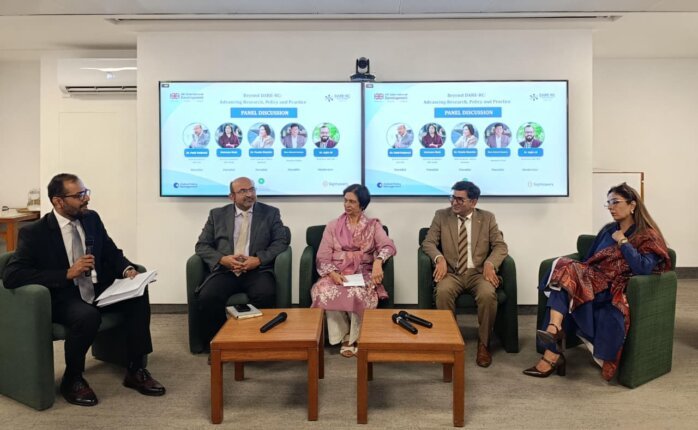
A panel discussion, Sustaining Research Impact Beyond DARE-RC, moderated by Dr Sajid Ali, featured Dr Farid Panjwani and Dr Dilshad Ashraf of AKU-IED, Prem Sagar of Ministry of Education, and Memona Shah of the Sindh Higher Education Commission and Dr Fauzia Shamim of Durbeen. Panellists explored pathways to accelerate policy uptake, strengthen institutional ownership, and ensure the long-term sustainability of research-informed reforms.
A Research Gallery Walk alongside the sessions displayed DARE-RC studies on climate-resilient schooling, education data governance and standards for frontline teaching.


