


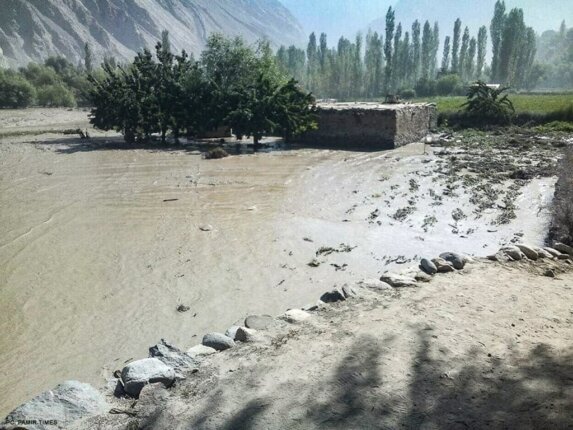
Gilgit-Baltistan is facing a worsening humanitarian and infrastructure crisis after a fresh wave of flash floods on Wednesday forced authorities to suspend repair work on the Karakoram Highway (KKH). The suspension has left thousands of travellers — including local residents and foreign tourists — stranded at multiple points across the mountainous region.
Rescue 1122 confirmed the situation in Gulmit Gojal, Hunza, saying restoration efforts stopped after floodwaters from Juchar Nullah swept into the area. Gilgit-Baltistan government spokesperson Faizullah Faraq said rehabilitation work was ongoing in several flood-hit districts but was severely hampered by rising water levels, riverbank erosion, and landslides.
“Passengers and vehicles are waiting for the road to reopen on both sides of Gulmit Gojal,” Faraq said, adding that stranded people were being moved through an alternative wooden bridge. He noted that urgent instructions had been issued to speed up repairs in Shigar, Ghizer, Hunza, Gilgit, Astore, Diamer, and other affected areas.
The flooding, fuelled by rapid melting of the Shisper Glacier, has already destroyed more than 15 houses in Hasanabad, Hunza. Entire families have been forced to abandon their homes, with some dismantling their properties to salvage materials. “Life in Hasanabad has come to a standstill,” the spokesperson said.
The flood has also damaged vital infrastructure, including sections of the KKH, an optical fibre network, and electricity transmission lines. Mobile and internet services have been cut off in parts of Hunza, and power outages have hit multiple localities.
Rescue 1122 reported that the torrent destroyed thousands of kanals of forest, fruit orchards, agricultural land, three link roads, five irrigation channels, three wooden bridges, and a popular roadside restaurant. Around 60–70 people narrowly escaped disaster after a last-minute warning of the approaching flood.
Authorities have deployed heavy machinery to restore access along the KKH, while relief teams work around the clock to assist displaced families. “We will not rest until all affected people are rehabilitated,” Faraq vowed.


